
July 2, 2025

Making an Apartment More Sustainable: Costs and Benefits in 2025

Introduction

Contents

Making an Apartment More Sustainable: Costs and Benefits in 2025

Making an apartment more sustainable is a smart investment for landlords and homeowners. Not only does it increase the value of your home and the rental points via the Housing Valuation System (WWS), but it also reduces energy costs and contributes to a more sustainable future. In 2025, with stricter regulations such as the Affordable Rent Act and the target of energy label B for social housing, sustainability will be more relevant than ever. In this blog, we discuss how you can make an apartment more sustainable, what costs are involved, and what benefits this brings, such as higher WWS points and CO2 reduction. These insights are inspired by practical experiences shared in guest lectures on property management.

Why make an apartment more sustainable?

Making an apartment more sustainable offers multiple advantages, both financially and socially:

  • Higher WWS points: An improved energy label (e.g., from E to A) can yield up to +43 WWS points, which increases the maximum rent (e.g., from €681.44 to €1,025.87 for mid-range rentals).
  • Rental value increase: More WWS points mean higher rental income, especially in cities such as Rotterdam, Amsterdam, Utrecht, and The Hague.
  • Lower energy costs: Tenants benefit from lower bills, which makes apartments more attractive and reduces vacancy rates.
  • CO2 reduction: Energy-efficient apartments contribute to sustainability goals, such as a CO2 reduction of 3,500 kg per home per year.
  • Future-proofing: With the Affordable Rent Act (July 2024) and stricter energy standards, sustainability measures prevent rent reductions and loss of value.

Example: A 50 m² apartment in Utrecht with energy label F (-9 points) can earn 46 extra WWS points when upgraded to label A (+37 points), which increases the rent by hundreds of euros per month.

How can you make an apartment more sustainable? Practical measures

Making an apartment more sustainable requires targeted measures that improve energy performance, as often discussed in guest lectures on property management. Here are the most effective options:

  1. Solar panels (PV panels): Installing 4-6 solar panels (440WP) on flat roofs or shared roofs of apartment complexes reduces energy consumption. Cost: €4,000–€6,000 (for 6 panels). WWS impact: Contribution to label A (+37 points).
  2. Facade insulation: Interior insulation (e.g., Eurothane G, Rc≥3.5) for exterior walls reduces heat loss. Cost: €8,000–€12,000 for 60 m². WWS impact: Essential for label A/B.
  3. HR++ glass: Replacing single or old double glazing with HR++ glass improves the insulation of windows. Cost: €2,500–€4,000 for 10 m². WWS impact: Increases energy performance.
  4. Decentralized heat recovery ventilation: CO2-controlled heat recovery units optimize ventilation and comfort. Cost: €2,500–€3,500 per unit. WWS impact: Supports label A.
  5. Hybrid heat pump: Combines efficient heating with existing central heating boilers. Cost: €4,000–€6,000. WWS impact: Significantly reduces energy consumption.

Total costs: For an average apartment of 50 m², we estimate the costs at €21,000–€31,000 for an upgrade from label E/F to A, depending on the condition of the property and the measures chosen.

Subsidies: Take advantage of the Sustainable Energy Investment Subsidy (ISDE) (€1,500 for heat pumps) and the Rental Property Sustainability Subsidy (SVOH) (up to €3,000 for insulation). These can reduce costs by 20-25%, as in a Rotterdam project where we reduced the cost per home from €17,500 to €13,160.

Cost-benefit analysis: What are the benefits of sustainability?

The investment in sustainability pays for itself through higher rents, increased property values, and lower energy costs. Here is an overview of the benefits, based on practical experience:

  • Rental value increase: An apartment with energy label A can earn 46 extra WWS points (from F to A), which increases the rent from €681.44 (social) to €1,025.87 (mid-range) or even €1,200+ (private sector at 187+ points). This means an extra €4,000–€6,000 per year in rental income.
  • Increase in value: An energy-efficient apartment is more attractive to investors, with an estimated increase in value of €30,000–€50,000, as seen in projects in Utrecht.
  • CO2 reduction: Upgrading to label A saves approximately 3,500 kg of CO2 per year, contributing to sustainability goals.
  • Return on Investment (ROI): With subsidies and rent increases, the ROI is often 15-20%, as in a project in The Hague where we achieved label A within 5 years.
  • Tenant benefits: Lower energy costs (savings of up to €500/year) and improved comfort reduce vacancy rates.

Example: In a Rotterdam project, we upgraded apartments from energy label E to A, with an investment of €13,160 after subsidies. The rent increased by €400/month, resulting in an annual income increase of €4,800 and recouping the investment in less than 3 years.

Why invest in sustainability now?

With the Affordable Rent Act (July 2024) and the target of energy label B for social housing by 2030, sustainability is essential. Apartments with low labels (E, F, G) risk rent reductions by the Rent Assessment Committee and falling market value. Sustainability to label A offers:

  • WWS compliance: Compliance with mandatory point scoring, as required in Rotterdam and Utrecht.
  • Competitive advantage: Energy-efficient apartments are popular in cities such as Amsterdam and The Hague.
  • Future-proofing: Preparing for stricter energy standards in 2030.

Practical example: In an Amsterdam project, we upgraded an apartment from label F to A, which increased the WWS points by 46 and brought the rent to mid-range. This increased the market value by €45,000.

How do you start becoming more sustainable?

  1. Have an energy label analysis performed: Check the current label via EP-Online and identify bottlenecks.
  2. Choose cost-effective measures: Focus on solar panels, insulation, and ventilation for maximum impact.
  3. Take advantage of subsidies: Apply for ISDE and SVOH to reduce costs.
  4. Work with experts: A consultant can provide a cost-benefit analysis and WWS report for optimal results.

Would you like to make your apartment more sustainable and increase its rental value? Contact us for a no-obligation consultation!

I want to upgrade my label!

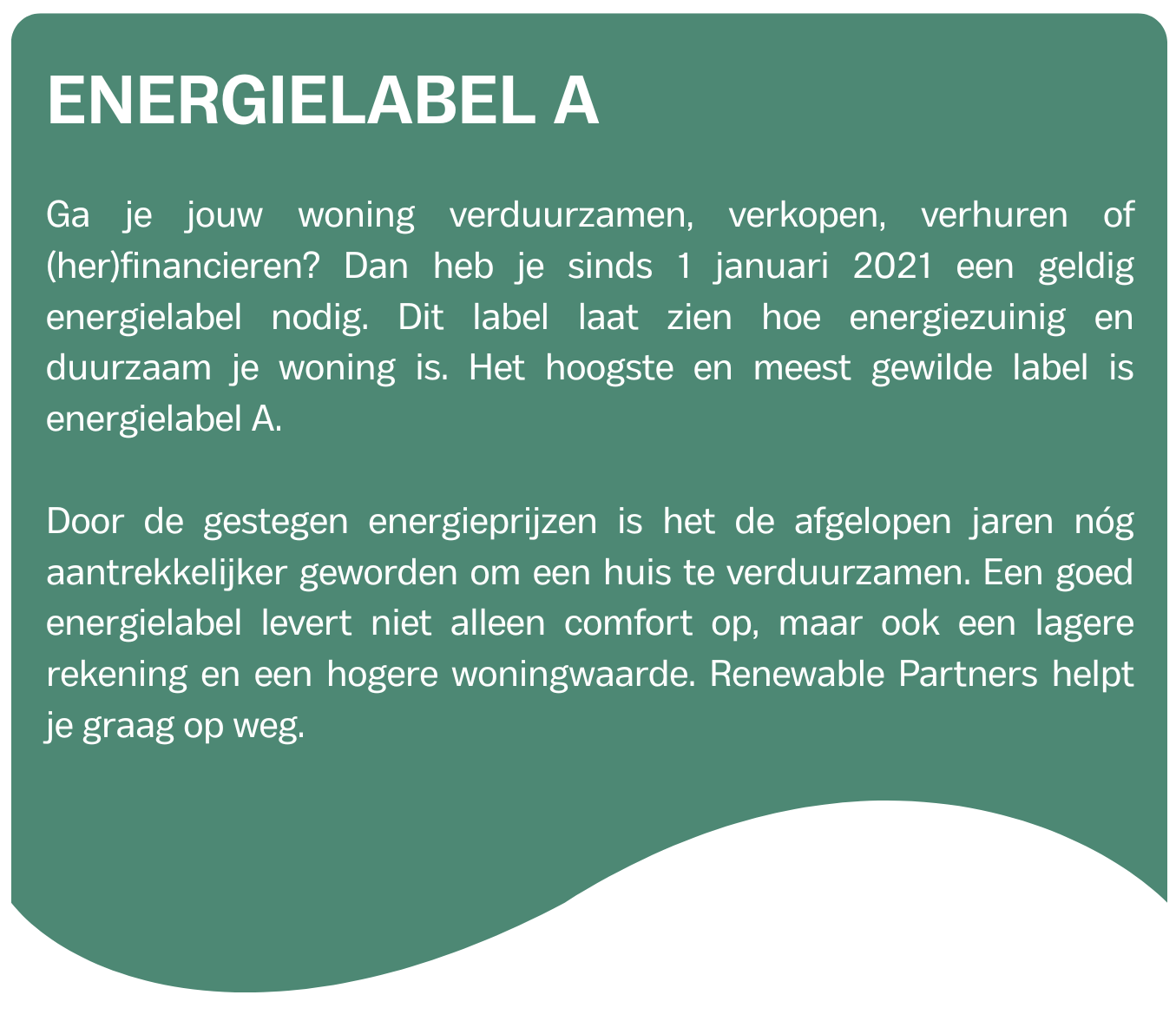
What is the difference between energy label A and A+++?

The difference lies mainly in the degree of insulation and the proportion of sustainably generated energy. An A label can be achieved with good insulation and an efficient installation. For A+++, more is needed: a large proportion of the energy must be generated sustainably, for example with solar panels and a heat pump.

What requirements must my home meet to qualify for energy label A?

The energy label is determined based on the fossil energy consumption of the home, expressed in kWh/m² per year. For an A label, this value is between 105 and 160 kWh/m² per year. With good insulation, an A label is easily achievable. Homes built after 1991 often already have sufficient basic insulation to fall into this category. Solar panels are therefore not necessarily required to achieve an A label.

What are the benefits of an A label?

  • An A-label home is excellently insulated.
  • You enjoy greater living comfort and lower energy bills.
  • You are contributing to a better climate.
  • Many banks offer interest rate discounts on mortgages for homes with an A label (average 0.1%–0.2%).
  • With an average home value of €387,000, this can amount to savings of €500–€1,500 per year.
  • I want to register my energy label!

    What our business customers say about Renewable Partners

    Practical experience – reliable energy expertise and results-oriented collaboration

    Frequently Asked Questions

    What does Renewable Partners do?
    Who are your services for?
    What is a WWS advisory report?
    How much does an energy label cost?
    Technology & Innovation
    |
    July 2, 2025

    Making an Apartment More Sustainable: Costs and Benefits in 2025

    Making an Apartment More Sustainable: Costs and Benefits in 2025

    Introduction

    Making an Apartment More Sustainable: Costs and Benefits in 2025

    Making an apartment more sustainable is a smart investment for landlords and homeowners. Not only does it increase the value of your home and the rental points via the Housing Valuation System (WWS), but it also reduces energy costs and contributes to a more sustainable future. In 2025, with stricter regulations such as the Affordable Rent Act and the target of energy label B for social housing, sustainability will be more relevant than ever. In this blog, we discuss how you can make an apartment more sustainable, what costs are involved, and what benefits this brings, such as higher WWS points and CO2 reduction. These insights are inspired by practical experiences shared in guest lectures on property management.

    Why make an apartment more sustainable?

    Making an apartment more sustainable offers multiple advantages, both financially and socially:

    • Higher WWS points: An improved energy label (e.g., from E to A) can yield up to +43 WWS points, which increases the maximum rent (e.g., from €681.44 to €1,025.87 for mid-range rentals).
    • Rental value increase: More WWS points mean higher rental income, especially in cities such as Rotterdam, Amsterdam, Utrecht, and The Hague.
    • Lower energy costs: Tenants benefit from lower bills, which makes apartments more attractive and reduces vacancy rates.
    • CO2 reduction: Energy-efficient apartments contribute to sustainability goals, such as a CO2 reduction of 3,500 kg per home per year.
    • Future-proofing: With the Affordable Rent Act (July 2024) and stricter energy standards, sustainability measures prevent rent reductions and loss of value.

    Example: A 50 m² apartment in Utrecht with energy label F (-9 points) can earn 46 extra WWS points when upgraded to label A (+37 points), which increases the rent by hundreds of euros per month.

    How can you make an apartment more sustainable? Practical measures

    Making an apartment more sustainable requires targeted measures that improve energy performance, as often discussed in guest lectures on property management. Here are the most effective options:

    1. Solar panels (PV panels): Installing 4-6 solar panels (440WP) on flat roofs or shared roofs of apartment complexes reduces energy consumption. Cost: €4,000–€6,000 (for 6 panels). WWS impact: Contribution to label A (+37 points).
    2. Facade insulation: Interior insulation (e.g., Eurothane G, Rc≥3.5) for exterior walls reduces heat loss. Cost: €8,000–€12,000 for 60 m². WWS impact: Essential for label A/B.
    3. HR++ glass: Replacing single or old double glazing with HR++ glass improves the insulation of windows. Cost: €2,500–€4,000 for 10 m². WWS impact: Increases energy performance.
    4. Decentralized heat recovery ventilation: CO2-controlled heat recovery units optimize ventilation and comfort. Cost: €2,500–€3,500 per unit. WWS impact: Supports label A.
    5. Hybrid heat pump: Combines efficient heating with existing central heating boilers. Cost: €4,000–€6,000. WWS impact: Significantly reduces energy consumption.

    Total costs: For an average apartment of 50 m², we estimate the costs at €21,000–€31,000 for an upgrade from label E/F to A, depending on the condition of the property and the measures chosen.

    Subsidies: Take advantage of the Sustainable Energy Investment Subsidy (ISDE) (€1,500 for heat pumps) and the Rental Property Sustainability Subsidy (SVOH) (up to €3,000 for insulation). These can reduce costs by 20-25%, as in a Rotterdam project where we reduced the cost per home from €17,500 to €13,160.

    Cost-benefit analysis: What are the benefits of sustainability?

    The investment in sustainability pays for itself through higher rents, increased property values, and lower energy costs. Here is an overview of the benefits, based on practical experience:

    • Rental value increase: An apartment with energy label A can earn 46 extra WWS points (from F to A), which increases the rent from €681.44 (social) to €1,025.87 (mid-range) or even €1,200+ (private sector at 187+ points). This means an extra €4,000–€6,000 per year in rental income.
    • Increase in value: An energy-efficient apartment is more attractive to investors, with an estimated increase in value of €30,000–€50,000, as seen in projects in Utrecht.
    • CO2 reduction: Upgrading to label A saves approximately 3,500 kg of CO2 per year, contributing to sustainability goals.
    • Return on Investment (ROI): With subsidies and rent increases, the ROI is often 15-20%, as in a project in The Hague where we achieved label A within 5 years.
    • Tenant benefits: Lower energy costs (savings of up to €500/year) and improved comfort reduce vacancy rates.

    Example: In a Rotterdam project, we upgraded apartments from energy label E to A, with an investment of €13,160 after subsidies. The rent increased by €400/month, resulting in an annual income increase of €4,800 and recouping the investment in less than 3 years.

    Why invest in sustainability now?

    With the Affordable Rent Act (July 2024) and the target of energy label B for social housing by 2030, sustainability is essential. Apartments with low labels (E, F, G) risk rent reductions by the Rent Assessment Committee and falling market value. Sustainability to label A offers:

    • WWS compliance: Compliance with mandatory point scoring, as required in Rotterdam and Utrecht.
    • Competitive advantage: Energy-efficient apartments are popular in cities such as Amsterdam and The Hague.
    • Future-proofing: Preparing for stricter energy standards in 2030.

    Practical example: In an Amsterdam project, we upgraded an apartment from label F to A, which increased the WWS points by 46 and brought the rent to mid-range. This increased the market value by €45,000.

    How do you start becoming more sustainable?

    1. Have an energy label analysis performed: Check the current label via EP-Online and identify bottlenecks.
    2. Choose cost-effective measures: Focus on solar panels, insulation, and ventilation for maximum impact.
    3. Take advantage of subsidies: Apply for ISDE and SVOH to reduce costs.
    4. Work with experts: A consultant can provide a cost-benefit analysis and WWS report for optimal results.

    Would you like to make your apartment more sustainable and increase its rental value? Contact us for a no-obligation consultation!

    Reviews

    What our business customers say about Renewable Partners

    Practical experience – reliable energy expertise and results-oriented collaboration

    Quote Icon
    Star IconStar IconStar IconStar IconStar Icon

    I have experienced Renewable Partners as a reliable and professional party in the field of sustainable energy. They think along well, are transparent in their communication, and deliver customized solutions that really meet the need.

    Arcen Day
    The Hague Project
    Quote Icon
    Star IconStar IconStar IconStar IconStar Icon

    Professional and readily available for questions. I am very satisfied with the service and can recommend the company. Kind regards,

    Anna Kalbarczyk
    Managing Director
    Quote Icon
    Star IconStar IconStar IconStar IconStar Icon

    While my energy label doesn't matter at all, new residents are going to renovate the entire house, Nik has still made a thorough and clear report of my old farmhouse. TOP job. Thanks

    Anke Hartman
    Founder of UrbanWave Solutions
    Quote Icon
    Star IconStar IconStar IconStar IconStar Icon

    The energy label inspector is a highly skilled professional who knows his trade. We were helped well and quickly with his advice. The reactions of this company are praising the price, the lowest, and the service, downright TOP!

    Jos Ernst
    Chief Operating Officer of PrimeLogistics
    Quote Icon
    Star IconStar IconStar IconStar IconStar Icon

    The recording was done carefully. All documents and construction dimensions were checked/recorded by the advisor Ronan van der Loo. And good advice was given. He finished the recording within 2 hours.

    Huub Aerts
    Head of Operations
    Review Left Arrow
    Review Right Arrow
    90%
    Customer satisfaction score
    Frequently Asked Questions

    Frequently asked questions

    What does Renewable Partners do?
    FAQ Icon
    Who are your services for?
    FAQ Icon
    What is a WWS advisory report?
    FAQ Icon
    How much does an energy label cost?
    FAQ Icon